

Is Florida Golf Bad?
Florida golf is misunderstood and a product of its environment.

Issue No. 60, March 5, 2026
The PGA Tour began the “Florida swing” last week at PGA National. To us, that course doesn’t look like a lot of fun, but it looks like a typical (or stereotypical) Florida golf course.
Welcome to the From the Drop Zone newsletter, where we’re wondering if Florida golf is bad or just misunderstood.
I know there are a lot of newsletters out there, and I’m thankful this one found its way into your inbox. Let’s hang out, pour a cocktail, and talk some golf.
This issue of the From the Drop Zone Newsletter is brought to you by members of The Circle Golfing Society. Join The Circle today, the official golfing society of From the Drop Zone, to support our writing and other projects, get discounts to events and merchandise, and be a part of a community of golfers who don’t mind a cocktail in the clubhouse after the round.
This issue is also brought to you by Acorn Hills. Manufacturer of the official From the Drop Zone Polo, we partner with Acorn Hills because of their industry-leading eco-friendly way of giving back to the environment and community. Their clothing tags are seed paper that can be planted and to eliminate waste. And their clothing is high-quality. Use code DROP15 at Acorn Hills to get 15% off your order.
There’s a moment on almost every Florida golf course when you look down at your ball, look up at the forced carry over water, and think “oh, again?!”
Florida golf doesn’t hide what it is. It is flat. It is wet. It is engineered.
And if you came here looking for rumpled fairways and wind-shaped greens that bleed into the horizon like the ones you walked at Royal County Down or Portstewart, you’re in the wrong place.
But that doesn’t mean Florida golf is bad.
It just means it’s a product of it’s environment.
The best golf in the world begins with movement.
Natural contours create strategy. Elevation creates decisions. Firm ground creates imagination.
Florida offers almost none of that.
Most of the state sits barely above sea level. The water table lurks inches below the surface. What isn’t swamp is sand. What isn’t sand is housing.
So architects do what they have to do. They have to dig lakes for drainage and use the spoil to elevate greens. They have to build courses between corridors of homes, condos, and HOA clubhouses. These courses have to manufacture interest.
The best architecture has holes that are “found.” But in Florida, holes are built.
That’s not to say that there aren’t some great golf courses in Florida. There are.
Seminole Golf Club has land that moves with a rare Atlantic dune ridge gives it elevation and wind exposure that most of South Florida can only dream about. Donald Ross didn’t have to invent drama here. He shaped within it.
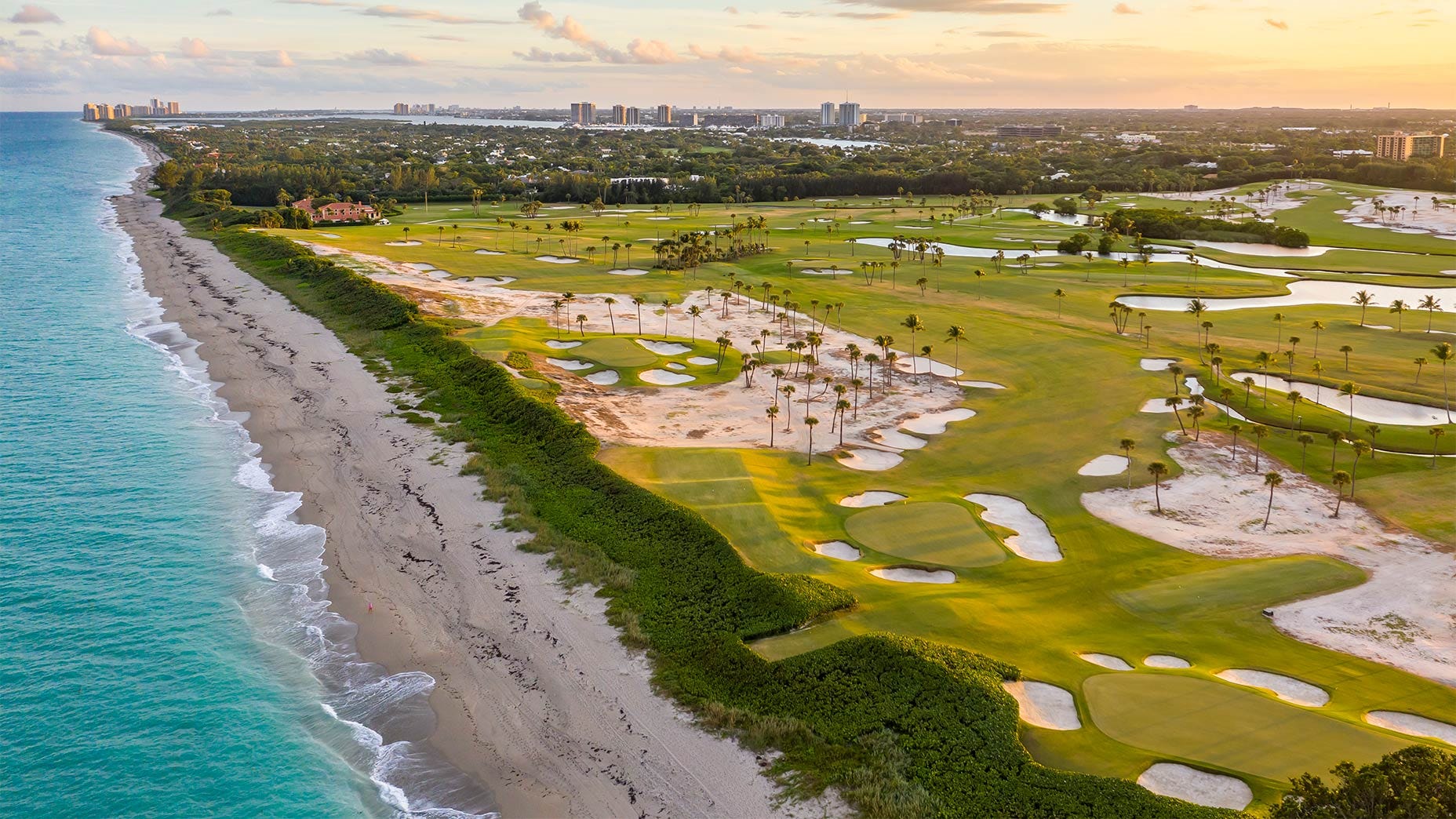
The greens are subtle. The angles matter. The wind dictates.
But Seminole was built in 1929. Decades before the master-planned golf community exploded across the state.
A more recent entry into Florida golf is Streamsong Resort. Florida’s most dramatic golf exists because of environmental destruction.
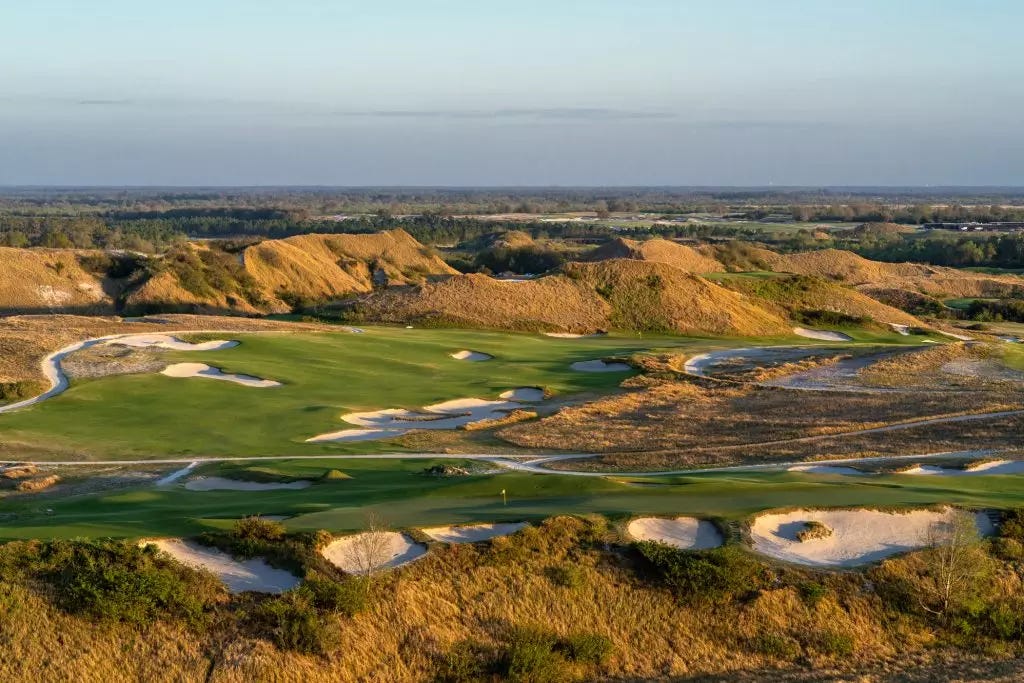
Phosphate mining left behind massive sand dunes and elevation changes that simply do not exist naturally in the state. Tom Doak, who designed the Red Course, and Bill Coore and Ben Crenshaw, who designed the Blue Course, leaned into it, and suddenly you have bold greens, exposed wind, and ground that can actually run.
Florida needed a mining scar to get some of the best golfing ground in the state.
If Florida is going to be artificial, it might as well be theatrical.
When designing TPC Sawgrass, Pete Dye understood that the land in Ponte Vedra Beach wasn’t going to give him romance. So he gave us spectacle.
The finishing stretch of the Stadium Course at TPC Sawgrass provides drama and theater perfect for the ending of a championship tournament. And if you play it, the 17th hole gets in your head from the minute you book the tee time.
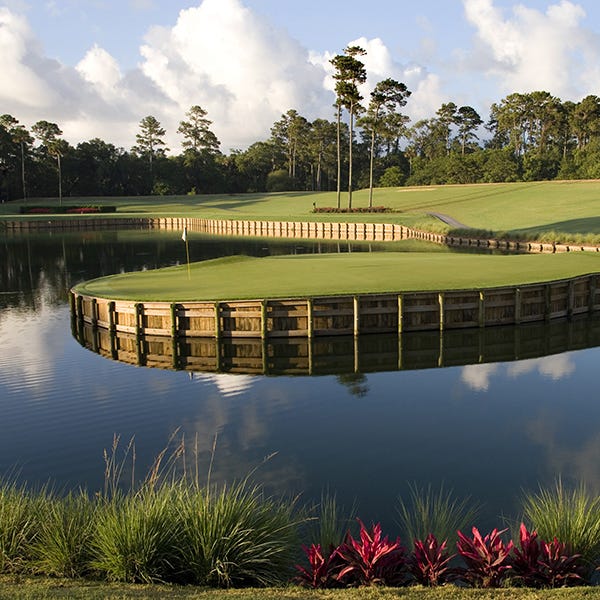
Sawgrass weaponizes Florida’s flatness into something psychological.
Now let’s talk about the typical Florida template.
You’ve seen it. You’ve played it. Houses tight left and right. A 160-yard carry over water on a par three. An elevated green built from dredged soil. Soft turf that erases the ground game. The holes start to blur together. Everything becomes target golf. Fly it here. Don’t miss there. Avoid the hazard. Sometimes it feels like a water park with flags.
There are fewer options. Fewer angles. Fewer moments where imagination beats execution. It becomes hazard management. And that’s rarely the highest form of the game.
Even good public courses can fall into this rhythm: wide fairways bordered by water, elevated greens, and repetition born from necessity rather than creativity.
But these designs aren’t necessarily incompetence.
And this is where perspective matters.
Florida golf isn’t built to be walked in the wind. It was built to drain after a thunderstorm. To survive hurricanes. To anchor housing developments. To host 200 players a day in February.
It is a product of climate, geography and commerce.
And while most Florida golf may not be great, it’s better that there is golf than no golf. After all, I need a place to play when there’s 14 inches of snow on the ground or its 11 degrees in the New Jersey winter.